

In brief
The article discusses the United Kingdom’s transition review of anti-dumping and countervailing duty measures on electric bicycles from China, where the UK Trade Remedies Authority concluded that continuation of measures on all e-bikes failed the Economic Interest Test. The article examines how the TRA collected and used economic information, how partial-equilibrium modelling was applied to assess different outcomes, and how the TRA’s economic assessment operated alongside the Secretary of State’s decision-making power.
Introduction
Trade remedy measures seek to address injury caused by dumped or subsidised imports. However, the imposition of duties may also affect importers, users and consumers through higher prices, changes in supply and reduced choice. This creates a question for investigating authorities: how should the economic cost of a trade remedy be assessed against the benefit of removing injury to the domestic industry?
In our earlier articles, we examined the place of public interest in India’s trade remedy framework,[1] and the need for a method to balance the interests of domestic producers and users through examination of the European Commission’s use of tariff rate quota in the Fused Alumina case to adjust the form of the measure.[2]
The United Kingdom’s transition review of anti-dumping (‘AD’) and countervailing duty (‘CVD’) measures on electric bicycles from China provides another approach to this issue. The UK Trade Remedies Authority (‘TRA’) found that dumping/subsidisation and injury were likely to recur if the measures disappeared. Ordinarily, that points towards continuation of measures. Instead, the TRA concluded that continuation of measures on all e-bikes failed the Economic Interest Test (‘EIT’). The TRA assessed the economic consequences of continuing, modifying or removing the measures. The TRA used partial-equilibrium modelling to compare the available outcomes of continuing, modifying or removing the measures. Consequently, the TRA gave the Secretary of State three choices: revoke measures entirely, continue measures entirely, or most interestingly modify measures. The third option was adopted by the Secretary of State leading to modification of measures.
This article examines how the TRA collected and used economic information, how partial-equilibrium modelling was applied to assess different outcomes, and how the TRA’s economic assessment operated alongside the Secretary of State’s decision-making power. It also considers what this approach may offer for the examination of economic interest in Indian trade remedy investigations.
The UK framework: Moving beyond an impose-or-revoke choice
The UK trade remedy framework requires the TRA to assess whether a proposed measure is in the economic interest of the UK. EIT considers factors such as injury to UK producers, benefits of removing that injury, impact on affected industries and consumers, employment, competition, market structure and geographical effects. In AD and CVD investigations, the EIT is presumed to be met unless the evidence shows otherwise.
Before 2023, the UK system operated through a two-tier decision-making structure which was similar to the present Indian framework. The TRA investigated the case and made its recommendation, while the Secretary of State took the decision on whether the recommendation should be accepted. This is similar to the two-tier structure followed by India. The UK Government noted that Ministers effectively had two choices: accept the TRA’s recommendation in full or reject it. This limited the ability of the Secretary of State to choose another form of measure where the wider public interest required a different outcome.[3]
This position was changed through Schedule 19 to the Finance (No. 2) Act 2023 and the Trade Remedies (Amendment) Regulations 2024. The amended framework permits the TRA to place two or more remedial options before the Secretary of State. Where options are given, the TRA must explain the reasons for each option, identify its preferred option and advise whether each option meets the EIT. The 2024 Regulations further require the TRA to consider giving more than one option where its proposed AD or CVD measure does not meet the EIT.
For transition reviews, such as the e-bike reviews, amended Regulation 100 applies the same approach. The TRA may recommend different options and the Secretary of State, upon accepting the recommendation containing those options, must decide which option to adopt.[4]
The amendment therefore changed the role of the EIT. TRA provides the economic assessment and compares the available options. The Secretary of State retains the decision on which option should finally be adopted in the public interest. This framework created the legal basis for the TRA to give options to the Secretary of State to either continue measures entirely, revoke measures entirely or modify measures.
Information collected by the TRA for EIT
In the e-bike transition reviews, the TRA did not rely only on submissions made by UK producers or importers. It combined information received from interested parties with trade data, market information and consumer evidence.
The TRA examined information on UK production, sales, imports, market shares, prices and the position of UK producers along with information from importers and retailers which was used to understand import prices, retail prices and the extent to which a change in duty could be passed on to consumers.
The TRA also sought information directly from consumers by conducting a consumer survey in a trade remedy review. TRA received 47 responses, which provided information on preferred brands and the importance of price in purchasing decisions. Later, the TRA in its annual report for 2024-25 stated that the e-bike review led it to use such surveys in other cases involving consumer products.[5]
Market and company data helped measure the effect on producers and businesses, while consumer evidence helped assess how buyers may respond to a change in prices. These inputs were then converted into assumptions on price pass-through, demand and substitution for use in the TRA’s economic model.
Partial-equilibrium modelling: Turning evidence into an economic result
The TRA then used partial-equilibrium modelling to convert the information collected into estimates of the economic impact of the measures. A partial-equilibrium model focuses on the market for the product under examination. It compares how prices, sales and welfare in that market may change if the trade remedy measure is continued or removed, while broadly keeping other factors unchanged. The TRA has stated that this modelling allows it to monetise economic impacts that were assessed mainly in qualitative terms in its earlier EIT assessments.
The model can be understood through a sequential chain:
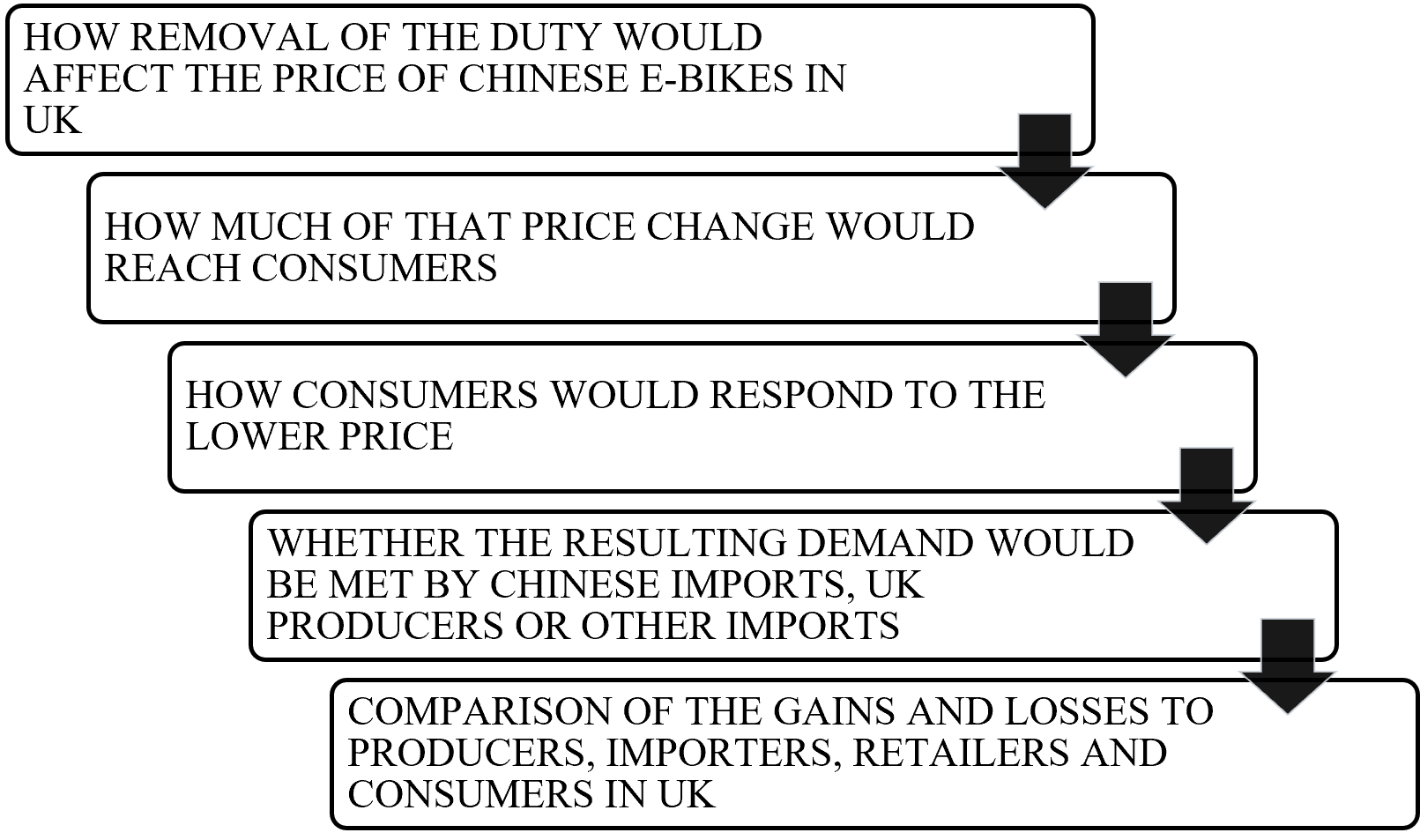
Partial-equilibrium modelling does not claim to predict exactly how the market will behave. Instead, it asks whether the direction of the result remains broadly the same when reasonable assumptions are changed. In the e-bike review, the modelling therefore provided a quantified answer to a practical question: whether the benefit of protecting UK producers was likely to outweigh the costs imposed on importers, retailers and consumers under different possible market responses.
The modelling exercise allowed the TRA to compare the economic effect of different forms of the measure. It considered three options: continuation of the duties on all e-bikes, continuation only on folding e-bikes, and revocation of the duties.
The TRA’s starting point remained the broader goods under review: electric cycles with pedal assistance and an auxiliary electric motor. It found that dumping/subsidisation and injury were likely to recur if the measures were revoked. It also found, however, that maintaining duties on all e-bikes failed EIT because the costs to consumers and other UK economic operators outweighed the benefits to UK producers.
Once the EIT failed, the reformed UK framework required TRA to consider whether there was an alternative remedial option. The question then became: could the measure be narrowed so that protection remained where it mattered most to UK production, while the cost imposed on the wider UK market was reduced? That inquiry led to folding e-bikes.
The distinction between folding and non-folding e-bikes arose at the stage of designing an alternative remedy. The TRA noted that UK producers were more concentrated in the folding e-bike segment, while non-folding e-bikes accounted for around 95% of the UK market. This created a different balance of interests across the two segments. Continuing duties on all e-bikes would impose costs across almost the entire consumer market. Limiting the measure to folding e-bikes would retain protection in the segment where UK production was more concentrated while removing the duty from the segment accounting for most UK consumption.
The model did not determine the final policy decision. Instead, it quantified the likely consequences of each option and allowed those options to be compared on the same basis. The TRA provided the economic assessment, while the Secretary of State retained the discretion to determine which option should be adopted in the public interest.
The lesson for India
India already has a basis for undertaking this exercise. The DGTR’s Economic Interest Questionnaire seeks information from producers, exporters, importers, users, consumers and government bodies on the effect of the proposed measure. It seeks information on issues such as demand and supply, availability of substitutes, dependence on imports, capacity and production, prices, employment, investment, exports and the effect of duty on downstream operations. Parties are also required to quantify the impact of imposition or non-imposition of the measure, wherever possible.[6] The next step is to examine the information in a form which depicts economic modelling.
However, improvement in examination of data alone may not address the present institutional issue. Under the existing Indian framework, the DGTR investigates and recommends a measure, while the Ministry of Finance (‘MoF’) decides whether that measure should be imposed. In practice, where public interest concerns arise, the final choice may become one between imposing the recommended measure and not imposing it. As discussed in our earlier article, this can leave the interests of the domestic industry and the user industry without a method of balancing them through another form of measure.
The UK experience provides a possible legislative approach. Rules 17 and 18 of the Anti-Dumping Rules, 1995 may be amended to expressly permit the DGTR to recommend more than one remedial option where the economic interest assessment shows that the usual form of duty may cause costs to users or consumers. For example, the DGTR may examine a lower duty, a reference-price duty, a tariff rate quota, a shorter duration or application of the duty only to an identified product segment.
For each option, the DGTR may be required to state the economic effect, whether the option meets the economic or public interest test and which option it prefers. Rule 18 may correspondingly permit the MoF to select one of the options after considering the DGTR’s analysis.
Such a framework would give the MoF choices other than accepting or rejecting the recommended duty when public interest concerns arise. The economic interest questionnaire would then become the starting point for a process in which the Authority verifies the information, converts it into measurable variables, models different outcomes and places the available remedial choices before the Government.
Conclusion
The UK e-bike reviews show that public interest assessment can move beyond competing submissions and be supported by economic modelling. Partial-equilibrium analysis allows an authority to test how different remedial options may affect prices, demand, sourcing and welfare. It does not replace discretion but provides a basis for exercising it.
It is important for Indian authorities to integrate a more nuanced public or user interest assessment into its final findings, particularly in sectors critical for the economy. This can be done by DGTR at the investigation stage by using evidentiary record for economic impact assessment of measures. If the DGTR gives different remedial options for measures to MoF through economic impact assessment, it may reduce the existing friction arising from MoF’s rejections of DGTR recommendations. This may also bring the required relief to the domestic industry while at the same time protect the larger economic interests of the public and users in India.
[The authors are Principal Associate and Associate, respectively, in International Trade & WTO practice at Lakshmikumaran & Sridharan Attorneys, New Delhi]
[1] LKS | Public Interest in India's Trade Remedy Law | LKS Attorneys
[2] LKS | Analysis of TRQ in EU's fumed silica case | LKS Attorneys
[3] https://parallelparliament.co.uk/bills/2022-23/financeno2/debates/ministerial-extracts
[4] https://www.policythreads.co.uk/document/43312/
[5] TRA Annual Report and Accounts 2024-25 - GOV.UK
[6] Economic Interest Questionnaire | Directorate General of Trade Remedies
Related Articles



Discuss this topic with our International Trade and WTO team
Contact Us