

In brief
Cross-border trade plays a vital role in boosting a country’s economic growth. With accelerated globalization, we have observed India emerging as one of the major players in the global supply chain. In the past decade, there has been a substantial rise in cross-border transactions; both in terms of volume and value and this rise has revealed various statutory hurdles in the extant applicable laws governing cross-border trade.
Cross-border trade plays a vital role in boosting a country’s economic growth. With accelerated globalization, we have observed India emerging as one of the major players in the global supply chain. In the past decade, there has been a substantial rise in cross-border transactions; both in terms of volume and value and this rise has revealed various statutory hurdles in the extant applicable laws governing cross-border trade.
New Export and Import Regulations
The Reserve Bank of India (‘RBI’) in its endeavor to promote Ease of doing Business, notified the Foreign Exchange Management (Export and Import of Goods and Services) Regulations, 2026 (‘New Regulations’) on 13 January 2026, followed by the issuance of the Directions on Export and Import of Goods and Services (‘New Directions’) on 16 January 2026 (collectively the ‘2026 Update’).
2026 Update: Implementation and Business Impact at a Glance
· The 2026 Update shall come into effect from 1 October 2026.
· The implementation of the 2026 Update will replace the existing regulatory framework, including the Foreign Exchange Management (Export of Goods & Services) Regulations, 2015, the Master Directions governing exports and imports, and the 167 circulars specified in the annexure to the New Directions (collectively, the 'Existing Provisions').
· The amendments introduced vide the 2026 Update are intended to streamline cross-border trade, simplify compliance requirements, and provide greater operational flexibility to authorised dealer banks (“AD Bank”) and businesses engaged in international transactions. As companies continue to align their trade, treasury, finance and compliance functions with the revised framework, it is critical to assess existing policies, documentation practices, contractual arrangements and foreign exchange management processes to ensure compliance with the new requirements and to leverage the operational benefits introduced by the RBI.
This article highlights the key changes introduced under the 2026 Update in relation to export-import payment timelines, reporting requirements, closure of low value transaction entries and outlines practical considerations for businesses navigating the revised regulatory landscape.
Import Transactions
Key Changes to Payment Timelines
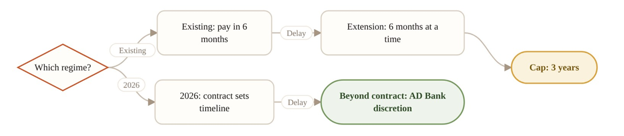
The Existing Provisions prescribe a 6 month timeline for settlement of import payments from the date of shipment or invoice, as applicable. AD Banks are permitted to grant extensions where satisfied as to the bona fides of the delay, for periods of up to 6 months at a time, subject to an overall period of 3 years. | In contrast, the 2026 Update does away with the prescribed 6 month payment period and allows the settlement timeline to be determined by the contractual terms agreed between the importer and the overseas counterparty. Any extension beyond the contractual period may be considered by the AD Bank based on the bona fides of the delay and its internal policies. This represents a shift from a regulator-prescribed timeline to a more contract-driven framework, with greater discretion being placed with AD Banks. |
This change is expected to provide businesses with greater flexibility in structuring supplier payment arrangements, particularly in industries where extended credit periods are commercially prevalent. The amendment also enhances alignment between foreign exchange regulations and actual commercial practices.
Points to Note
· The 2026 Update further clarifies that the payment timeline framework applies not only to imports of goods but also to imports of services. Although the 6 month settlement timeline prescribed under the Import Directions had, in practice, been extended by AD Banks to service imports, the New Regulations now formally recognize this position, thereby removing ambiguity and creating a uniform compliance framework for all import transactions.
· It is pertinent to note that the treatment of free-of-cost imports remains unaddressed under the 2026 Update. Given the increasing prevalence of cross-border supply chains involving samples, warranty replacements, promotional materials and intra-group transfers, stakeholders may expect additional guidance from the RBI or operational clarification from AD Banks on this aspect.
Export Transactions
Key Changes to Payment Timelines and Reporting Compliances
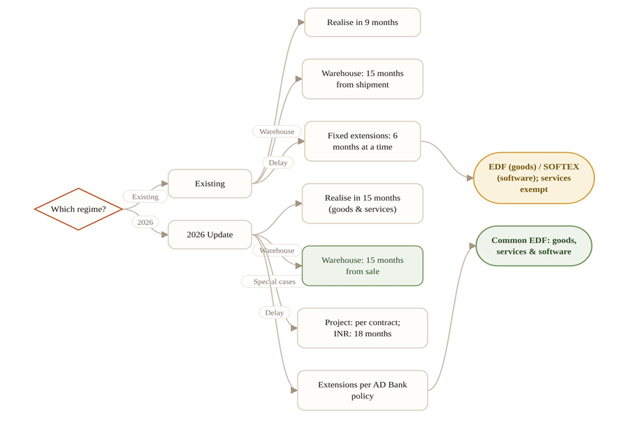
Under the Existing Provisions, export proceeds are generally required to be realized within 9 months from the date of export, while a period of 15 months from the date of shipment applies to goods exported to an overseas warehouse. | The 2026 Update prescribes that the export proceeds must be realized within 15 months from the date of shipment in the case of goods and from the date of invoice in the case of services and software. For goods exported to an overseas warehouse, the 15-month period will be computed from the date of sale of the goods from the warehouse rather than the date of shipment. Project exports will be governed by the payment terms agreed under the underlying contract, while an extended period of 18 months will apply where exports are invoiced and/or settled in Indian Rupees. |
AD Banks may grant extensions of up to 6 months at a time, subject to the prescribed conditions. | Instead of prescribing fixed extension periods, the 2026 Update enables AD Banks to grant extensions in accordance with their internal policies. |
From a reporting perspective, exports of goods are reported through the Export Declaration Form (“EDF”), with the Shipping Bill treated as the EDF for exports through EDI ports, whereas software exports are reported through the SOFTEX form. Export of services, on the other hand, is not subject to a corresponding export declaration requirement. | The 2026 Update also streamlines the export reporting framework by introducing a common EDF mechanism for exports of goods, services and software, replacing the existing fragmented reporting structure and, importantly, brings service exports within the export declaration framework. |
Points to Note
· The 2026 Update establishes a more integrated and streamlined reporting framework by introducing a common EDF for exports of goods, services and software. Under the Existing Provisions, exports of goods were reported through EDF, software exports were reported through SOFTEX forms and there was generally no corresponding export declaration requirement for services. The revised framework seeks to eliminate this fragmentation by creating a single reporting architecture applicable across all categories of exports.
· For exports of services, the EDF is required to be filed with the specified authority within 30 days from the end of the month in which the corresponding invoice is raised. To ease administrative compliance, the 2026 Update permits exporters of services to file a single consolidated EDF covering services exported to one or more recipients during a particular month. In the case of services other than software, the EDF may be submitted on or before the date of receipt of the corresponding payment.
· The AD Bank may extend the timeline for submission of the EDF upon being satisfied as to the bona fides of the request.
Specified authority for submission of EDF
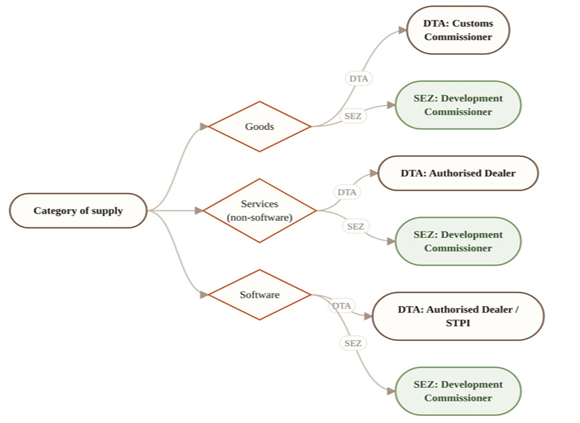
Free of Cost Exports
· A welcome procedural simplification under the 2026 Update is the removal of the requirement to obtain an EDF waiver for exports undertaken without consideration. Exporters may instead report such transactions by declaring a “nil” export value in the EDF, without the need to seek prior approvals.
· This is expected to simplify the compliance process for non-commercial exports and reduce the administrative burden associated with obtaining specific regulatory approvals. Service exporters, however, will need to revisit their existing invoicing and compliance processes to ensure that the new EDF reporting obligations are appropriately integrated into their systems and completed within the prescribed timelines.
Simplified Closure of EDPMS and IDPMS Entries for Low-Value Transactions
· The RBI, vide Notification No. RBI/2025-26/89, A.P. (DIR Series) Circular No. 12 dated 1 October 2025, introduced a significant compliance relaxation for low value transactions.
· EDPMS and IDPMS entries relating to transactions up to ₹10 lakh (or its equivalent in foreign currency) may be closed based on a declaration from the exporter confirming realization of the export proceeds or from the importer confirming payment of the import amount, as applicable.
· Similarly, any reduction in the declared or invoice value reflected in the relevant shipping bill or bill of entry may be accepted on the basis of a declaration furnished by the concerned exporter or importer. Such declarations may also be submitted on a consolidated quarterly basis.
· The continuation of this simplified mechanism under the 2026 Update reinforces the RBI’s broader objective of reducing the documentary and procedural burden associated with low-value trade transactions. By permitting closure or reconciliation based on trader declarations, the framework is expected to facilitate more efficient resolution of EDPMS and IDPMS entries. Its practical effectiveness, however, will depend on how AD Banks operationalize the relaxation, particularly whether they rely on the prescribed declarations or continue to seek additional supporting documentation under their internal policies and procedures.
While the 2026 Update reflects a clear intent to liberalize and simplify the foreign exchange regulatory framework governing trade transactions, the extent to which these relaxations translate into a tangible ease of doing business remains to be seen. Whether the envisaged liberalization results in a corresponding reduction in compliance obligations in practice will depend largely on how AD Banks recalibrate their internal policies and processes, as the practical impact of these reforms will ultimately be shaped by their implementation at the operational level. In particular, AD Banks may continue to require certain documentation and compliance measures under their internal policies and standard operating procedures, unless such requirements are expressly dispensed with under the New Regulations. With the 2026 Update set to come into force in the coming weeks, stakeholders will be keenly awaiting further operational guidance from AD Banks to assess the true scope and practical impact of these reforms.
Key Action Points for Businesses
In light of the 2026 Update, businesses should consider taking the following preparatory measures to align their existing trade and compliance framework with the revised requirements:
· Review contractual arrangements: Revisit master supply agreements, import and export contracts, Purchase Orders (PO) to align payment and collection terms with the enhanced flexibility provided under the 2026 Update.
· Reassess treasury and monitoring systems: Evaluate whether existing treasury and internal monitoring systems are equipped to track the revised timelines applicable to export realization and import payments.
· Revised EDF framework: Assess the impact of the new EDF reporting framework on export of services and software and update internal compliance procedures accordingly.
· Engage with AD Banks: Proactively engage with AD Banks to understand revised documentation requirements, extension policies and operational implementation approaches.
· Update internal compliance framework: Update internal FEMA compliance manuals, standard operating procedures and trade compliance checklists before the regulations become effective on 1 October 2026.
· Assess transitional transactions: Identify ongoing transactions that may straddle the transition date and determine the applicable regulatory treatment in consultation with AD Banks.
A detailed analysis of the 2026 Update is available here.
[The authors are Executive Partner, Associate Partner and Senior Associate, respectively, in Corporate practice at Lakshmikumaran & Sridharan Attorneys]
Related Articles
RBI releases FEMA 2026 Export-Import Trade Regulations: What businesses need to know
Asish Philip Abraham+223 Jan 2026

Unravelling the power of seizure under Section 37A of FEMA
Mahendra Singh+224 Jun 2025
Discuss this topic with our General Corporate team
Contact Us