

In brief
In the evolving landscape of modern commerce where visual appeal often dictates consumer choice, the significance of packaging has transcended its conventional role as a mere container of goods. In the realm of Intellectual Property Law, trade dress today functions as a silent yet powerful source identifier, one that shapes consumer perception, builds brand loyalty, and distinguishes products in crowded marketplaces.
Introduction
In the evolving landscape of modern commerce where visual appeal often dictates consumer choice, the significance of packaging has transcended its conventional role as a mere container of goods. In the realm of Intellectual Property Law, trade dress today functions as a silent yet powerful source identifier, one that shapes consumer perception, builds brand loyalty, and distinguishes products in crowded marketplaces. In industries dealing with everyday commodities, particularly fast-moving consumer goods, even a fleeting glance at a product’s packaging can influence purchasing decisions.
However, this reliance on visual identity also opens the door to trade dress passing off, as observable through the increased number of rights holders approaching Courts not only to protect their trademarks, but also their packaging and get-up i.e., trade dress. One such dispute was observed in the case of GRM Foodkraft Pvt. Ltd. v. KS Agro Impex[1], where a Single Judge of the Delhi High Court examined whether the defendants’ packaging was a legitimate market variation or a calculated attempt to ride on the plaintiffs’ established goodwill. Through this decision, the Court revisited the foundational doctrine of passing off in the context of trade dress, emphasizing that in commercial reality, it is the overall impression, rather than minute differences, that determines consumer confusion.
Background and brief facts of the case
The Plaintiffs, GRM Foodkraft Pvt. Ltd. and its parent entity, are well-established players in the rice milling and export industry, having commenced their business as early as 1974 and expanding their presence to over 38 countries worldwide. Over the years, the Plaintiffs have built a strong reputation in the market, particularly in the basmati rice segment, supported by substantial sales turnover and widespread recognition. In 2021, the Plaintiffs launched their product Golden Sella Basmati Rice under the house mark ‘10X’ and the sub-brand ‘Zarda King’, which was accompanied by a distinctive and aesthetically crafted packaging/trade dress. The said packaging featured a unique combination of green and gold colour scheme, stylized Urdu/Arabic-inspired lettering, lantern and star motifs, crescent moon imagery, architectural elements and a depiction of a pulao dish, which together contributed to a strong visual identity and recall value among consumers. The Plaintiffs’ product witnessed considerable commercial success, generating revenues exceeding ₹86 crores within a short span of three years.
In or around July 2024, the Plaintiffs came across the Defendant No.1’s product being sold in the market under the name ‘Zarda Special’ (‘impugned packaging’), which bore a striking resemblance to the Plaintiffs’ packaging. Upon closer inspection, the Plaintiffs observed that the Defendant had adopted a similar green and gold colour scheme, stylized lettering resembling Urdu script, analogous placement of the word ‘Zarda’, and similar visual elements such as lanterns, stars, and food imagery, thereby creating an overall appearance that was deceptively similar to that of the Plaintiffs’ product.
A comparative of the rival packaging is as follows: -
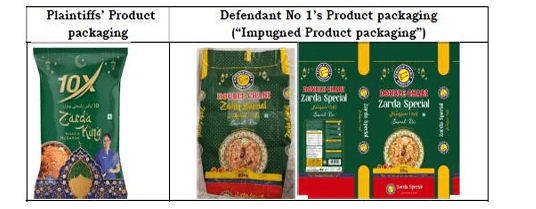
Aggrieved by the same, the Plaintiffs conducted a market survey which indicated a likelihood of confusion among consumers and subsequently approached the Delhi High Court seeking injunction against passing off of their trade dress and alleging and copyright infringement. On August 01, 2024, the Court granted an ex parte ad interim injunction in favour of the Plaintiff, while permitting Defendant No. 1 to carry on its business by using a different trade dress.
Despite the said injunction, Defendant No.1 sought its vacation and proposed modified packaging; however, the Plaintiffs alleged that even the revised packaging remained deceptively similar. This sequence of events ultimately culminated in the present proceedings before the Delhi High Court, where the Court analysed whether the rival trade dresses were deceptively similar.
Submissions of the plaintiff
The Plaintiffs contended that they had, through continuous and extensive use since 2021, built substantial goodwill and reputation in the packaging/trade dress of its product ‘10X Zarda King’ for Golden Sella Basmati Rice. It was alleged that the distinctive combination of green and gold colour scheme, stylized Urdu/Arabic-inspired font, lantern and crescent imagery and overall layout had become uniquely associated with the Plaintiffs in the minds of consumers.
The Plaintiffs highlighted that the Defendants had dishonestly adopted packaging which is a near replica, copying essential and prominent elements of the Plaintiffs’ trade dress including the colour combination, stylized lettering, use of the word ‘Zarda’, and other elements. It was argued that such imitation was deliberate and intended to mislead the public into believing that the Defendants’ product was associated with the Plaintiffs.
To support its claim of goodwill and distinctiveness, the Plaintiff relied upon its substantial sales figures and marketing efforts, including revenues exceeding ₹86 crores within three years and advertising expenditure of over ₹8 crores. The Plaintiffs also placed reliance on brand endorsements, digital promotions, and listings across trade platforms to demonstrate strong market presence and consumer recall.
The Plaintiffs further relied on a market survey conducted across 7 cities, comprising 208 participants including hawkers, retailers and distributors, which revealed high recall and recognition of the Plaintiffs’ packaging. The survey indicated that 81% of respondents were aware of the Plaintiffs’ packaging and 85% could identify it from a distance, while a portion of respondents associated the Defendants’ product with the Plaintiffs, establishing a likelihood of confusion among consumers.
The Plaintiff asserted that the present case satisfied the trinity test of passing off, namely[2]:
- existence of goodwill and reputation in the trade dress;
- misrepresentation by the Defendant through adoption of deceptively similar packaging; and
- likelihood of damage to the Plaintiff’s goodwill and business interests.
It was further submitted that the rival products are identical in nature, both being Golden Sella Basmati Rice, sold through the same trade channels and targeted at the same class of consumers, thereby increasing the likelihood of confusion, particularly among purchasers with average intelligence and imperfect recollection.
The Plaintiffs emphasized that the test of deceptive similarity must be based on the overall visual impression rather than a comparison of individual elements in isolation[3]. It was argued that even if certain elements such as colours or motifs are individually generic, their unique combination and arrangement in the Plaintiffs’ packaging have acquired distinctiveness and is entitled to protection.
The Plaintiffs also refuted the Defendants’ reliance on the word ‘Zarda’ being generic, contending that even assuming the word is descriptive, the cause of action arises from the overall imitation of the trade dress, and not merely from the use of the word itself. The addition of the suffix ‘Special’ by the Defendants, it was argued, does not sufficiently distinguish the products or dispel confusion.
Further, the Plaintiffs submitted that the use of the Defendants’ house mark ‘Double Chabi’ is insufficient to negate the likelihood of confusion, particularly in the context of edible goods like rice, where purchasing decisions are largely driven by visual cues such as colour and packaging rather than careful reading of brand names. Accordingly, the Plaintiffs prayed for confirmation of the interim injunction, restraining against the Defendants from using the impugned packaging or any other deceptively similar trade dress.
Submissions of the defendants
KS AGRO IMPEX, the Defendants, contended that it is a well-established business entity engaged in the sale and export of various rice products under its house mark ‘Double Chabi’. It was asserted that the Defendant has been in operation since 2016 and deals in multiple categories of rice products, thereby negating any allegation of attempting to unfairly encash upon the Plaintiff’s goodwill.
The Defendants strongly denied the allegation of deceptive similarity and submitted that the Plaintiffs cannot claim exclusive rights or monopoly over common elements such as colour combinations, decorative motifs like lanterns, stars, crescent moon, or imagery of food dishes. It was argued that such elements are generic and commonly used in trade, particularly in packaging of basmati rice products, and hence cannot be exclusively appropriated by any one trader.
The Defendants further contended that the word ‘Zarda’ is generic and descriptive, referring to a traditional sweet rice dish and derived from the Urdu word ‘Zard’ meaning yellow. It was submitted that several traders in the market use the term ‘Zarda’ to describe similar varieties of rice, and therefore the Plaintiffs cannot assert any exclusive right over the said word. The Defendants emphasized that even the Plaintiffs had, in its trade mark application, disclaimed exclusive rights over the word ‘Zarda’, thereby weakening its claim of exclusivity.[4]
The Defendants highlighted several points of dissimilarity between the rival packaging, including differences in background texture, the presence of polka dots, matte finishing, placement of design elements, colour strips, and arrangement of imagery. It was argued that when these distinctions are considered holistically, the packaging of the Defendants is sufficiently distinguishable and does not create any likelihood of confusion in the minds of consumers.
The Defendants also relied heavily on the prominent use of its house mark ‘Double Chabi’, which appears conspicuously on the packaging. It was submitted that the presence of a distinct and identifiable house mark is sufficient to indicate the source of the product and eliminate any possibility of confusion, particularly among consumers exercising reasonable care.
Further, the Defendants contended that the Plaintiffs have failed to establish the essential ingredients of passing off, namely goodwill, misrepresentation, and damage. It was argued that the Plaintiffs have only provided aggregate sales and advertising figures relating to its overall business under the ‘10X’ brand, without specifically establishing goodwill in the particular trade dress in question.[5]
The Defendants also questioned the credibility of the market survey relied upon by the Plaintiffs, describing it as self-serving and lacking probative value. It was submitted that there is no concrete evidence of actual confusion, consumer complaints, or financial loss suffered by the Plaintiffs as a result of the Defendants’ actions.
Additionally, the Defendants argued that the nature of the product and purchasing pattern, particularly the sale of rice in bulk quantities such as 30 kg bags, implies that the consumers are likely to be traders or experienced buyers who exercise a higher degree of care, thereby reducing the likelihood of confusion.
The Defendants further submitted that in the absence of registration of the trade dress or the mark ‘Zarda King’, the Plaintiffs cannot claim statutory protection, and its claim must be strictly tested under common law principles of passing off, which, according to the Defendants, have not been satisfied in the present case.
Lastly, the Defendants asserted that its adoption of the impugned packaging was bona fide and not dishonest, and that any similarity, if at all, is incidental and attributable to common industry practices rather than deliberate imitation. Accordingly, the Defendants sought vacation of the interim injunction, contending that the balance of convenience lies in its favour and that it should be permitted to continue using its packaging.
Analysis and decision
The Court analyzed the rival submissions, in light of the settled principles governing passing off and trade dress infringement and observed that the Plaintiffs are long-standing and reputable players in the rice industry, having built considerable goodwill and market presence over decades. The Court noted that the Plaintiffs have, through consistent use, extensive promotion and significant sales, established a distinctive identity in the packaging of their product ‘10X Zarda King.’
On the other hand, the Court was of the view that the Defendants’ adoption of the impugned packaging could not be regarded as a mere coincidence or an innocent act. It was observed that the Defendants had reproduced almost all essential and prominent elements of the Plaintiffs’ trade dress, including the green and gold colour combination, stylized lettering resembling Urdu/Arabic script, the placement and prominence of the word ‘Zarda’, and decorative features such as lanterns, stars and food imagery.
The Court emphasized that the test of deceptive similarity is not one of exact identity but of overall impression, and that competing trade dresses cannot be dissected into individual elements for comparison. Instead, the focus must be on whether the overall visual appearance is likely to cause confusion to a consumer of average intelligence and imperfect recollection. Relying on settled precedents, the Court reiterated that similarities must be given greater weight than dissimilarities, particularly in cases where imitation appears deliberate.[6]
Applying this principle, the Court found that the similarities between the rival packaging were striking and overwhelming, and the minor differences highlighted by the Defendants were insufficient to obviate the likelihood of confusion. The Court noted that consumers often rely on colour schemes, layout and visual cues, especially in the case of FMCG products such as rice, where customers may be literate or illiterate, and therefore the perspective of a man with average intelligence and imperfect recollection must be considered.[7]
The Court was further of the view that the Defendants’ reliance on the use of its house mark ‘Double Chabi’ was misplaced. It held that the mere presence of a house mark is not sufficient to dispel confusion, particularly where the overall trade dress is deceptively similar.[8] The Court observed that in real market conditions, the attention of consumers is first drawn to the visual appearance of the packaging, and not to the brand name printed thereon.
In dealing with the Defendants’ argument that the word ‘Zarda’ is generic, the Court held that even assuming the said word to be descriptive, the cause of action in the present case does not arise from the word alone, but from the overall imitation of the trade dress and visual presentation. The addition of the suffix ‘Special’ by the Defendants was found to be insufficient to create any meaningful distinction in the minds of consumers.
The Court also analyzed the evidence placed on record by the Plaintiffs, including their sales figures, marketing expenditure, celebrity endorsements and survey report, and concluded that the Plaintiffs had established substantial goodwill and distinctiveness in their trade dress. The Court noted that the market survey demonstrated consumer recognition and indicated a likelihood of association and confusion with the Defendants’ product.
Significantly, the Court characterized the Defendants’ conduct as an instance of ‘smart copying’, where sufficient similarities were retained to create confusion while minor variations were introduced to evade legal consequences.[9] The Court observed that such conduct reflects a deliberate intent to benefit from the Plaintiffs’ established reputation and goodwill.
In light of the above factors, the Court concluded that the Plaintiffs had successfully established a prima facie case of passing off, and that the balance of convenience lay in their favor. It was further held that if the Defendants were permitted to continue using the impugned packaging, it would cause irreparable harm to the Plaintiffs’ goodwill and brand identity, as well as mislead consumers.
Accordingly, the Court confirmed the ex parte ad interim injunction, restraining the Defendants from manufacturing, selling, or advertising its product in the impugned trade dress or any deceptively similar packaging. The Defendants were, once again, permitted to continue their business by adopting packaging that is clearly distinguishable and does not infringe upon the Plaintiffs’ rights.
Conclusion
In today’s fast-moving consumer market, packaging serves as a powerful identifier of origin and trust. This judgment reaffirms that distinctive trade dress, even if unregistered, is entitled to protection once it acquires goodwill and recognition.
Importantly, this decision makes a valuable contribution to the evolving jurisprudence on trade dress and passing off, particularly in FMCG and food markets, where visual appeal significantly shapes recall and purchase decisions. Ultimately, it reinforces that fair competition demands originality, not imitation.
The Court clearly established that reliance on descriptive or commonly used elements does not absolve a defendant who adopts an overall imitative trade dress to benefit from the reputation of an established competitor. Minor variations or ‘smart copying’ cannot negate deceptive similarity when the overall impression remains confusing.
[The author is Senior Associate in IPR practice at Lakshmikumaran & Sridharan Attorneys]
[1] CS(COMM) 637/2024.
[2] Reckitt & Colman Products Ltd. Respondents and Borden Inc. and Others Appellants [[1990] 1 WLR 491].
[3] Parle Products (P) Ltd. v. J.P. and Co., Mysore [(1972) 1 SCC 618]
[4] Sanjha Chulha v. Sanjha Chulha and Others [2022 SCC OnLine Del 3616].
[5] M.L. Brothers LLP v. Uma Impact Private Limited and Another [2023 SCC OnLine Del 1492].
[6] Munday v. Carey [22 RPC 273].
[7] Cadila Health Care Ltd. v. Cadila Pharmaceuticals Ltd. [(2001) 5 SCC 73].
[8] Skechers USA Inc v. Pure Play Sports [2016/DHC/4344].
[9] Allied Blenders alias Distillers Private Limited v. Hermes Distillery Private Limited [2024 SCC OnLine Del 217].
Related Articles


When a pump photo pumps up a legal dispute: Untangling copyright and design law
Divya Vishvapriya22 Oct 2025
Discuss this topic with our Intellectual Property team
Contact Us