
Click the 'View PDF' option above to download the Update.
Indirect Tax Update No. 41 of 2026
The 57th GST Council recommended the issuance of a circular providing comprehensive guidelines to tax officers to streamline the processes relating to the issuance of demand notices, adjudication orders and appeal orders. In line with this recommendation, Circular No. 258/04/2026-GST dated 26 October 2026 has been issued. Some of the key aspects discussed by the Circular are set out below:
Requirement to issue Summary in DRC-01 and DRC-02:
The circular has clarified that a summary should be issued along with the notice or statement, electronically in FORM GST DRC-01 and FORM GST DRC 02, respectively.
LKS Comments
The Circular specifically provides to issue summary SCN electronically in DRC-01 and DRC-02 along with the detailed SCN. It is not clear as to how the department is going to issue electronic DRC-01 and DRC-02 to the unregistered co-noticees such as employee, transporters etc.
Guidelines on structure and drafting of show cause notices (SCNs):
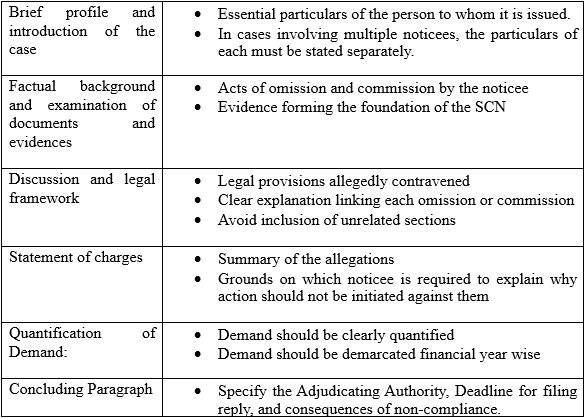
The following table summarises the elements to be included in an SCN, as outlined in paragraph 4 of the Circular:
Justification for invoking tax demand on grounds of fraud, wilful misstatement, or suppression of facts:
When the facts are known to both parties, an omission by one party does not constitute suppression.
An incorrect statement is not automatically a wilful misstatement; the latter requires a conscious making of a false statement with knowledge of its inaccuracy.
Section 74(1) or section 74A(5)(ii) of the CGST Act may be invoked only where the investigation discloses material evidence of such conduct, which must also be clearly set out in the SCN.
LKS Comments
This is a welcome clarification. In view of various judgements by the Hon’ble Courts, the department has clarified that invocation of Section 74 cannot be mechanical and specific cause has to be shown.
SCNs covering demands under sections 73 and 74 of the CGST Act:
Where a notice proposes demands under both Section 73 and 74, it must clearly state the reasons, factual and legal basis for bifurcating non-fraudulent from fraudulent demand.
Demand should be quantified separately under each category to eliminate ambiguity.
No parallel initiation of proceedings:
Section 6 of the CGST Act provides that where a proper officer under the SGST Act or the UTGST Act has already initiated proceedings in respect of a particular subject matter, no proceedings shall be initiated by a proper officer under the CGST Act in respect of the same subject matter.
CGST and SGST authorities should coordinate to ensure that there are no parallel proceedings by two different jurisdictional authorities on the same matter.
Timely issuance of SCNs:
As far as practicable, the proper officer should issue notices well in advance before the due date and avoid last-minute issuance.
Conduct of Personal Hearings (PH):
Adjudicating Authorities may grant maximum four personal hearing opportunities before any order requests. No further adjournment may be granted after the statutory limit.
Requests for appearances by authorized representatives under section 116 of the CGST Act should be duly considered.
The option of virtual hearing may be provided to the taxpayer.
After conducting personal hearings, the adjudication order should be communicated promptly, preferably within one month.
If personal hearing has already been conducted, the outgoing adjudicating authority who is transferred should, as far as practicable, endeavour to pass the order before relinquishing charge.
LKS Comments
Section 75(5) contemplated three opportunity of personal hearing whereas Circular in the interest of justice add one more opportunity of hearing. Therefore, in total, the authority should provide four opportunities of personal hearing for adjudication.
The Circular has instructed speedy disposal of cases preferably within 1 month of hearing while affording the taxpayers reasonable opportunities of being heard.
Guidelines on format of the Adjudication Orders:
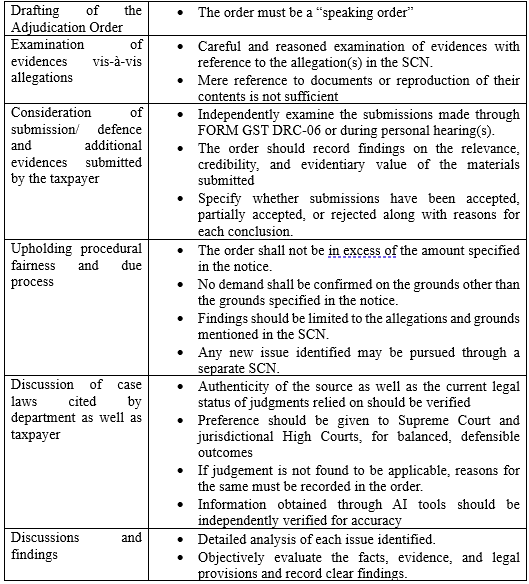
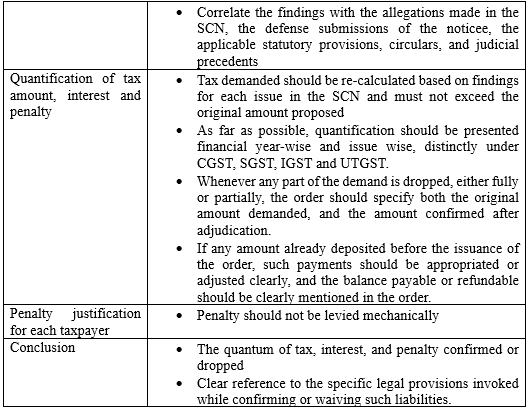
The following table summarises the major focus points as outlined in paragraph 11 of the Circular.
LKS Comments
The Circular specifically deals with the examination of evidence in the course of adjudication. However, Circular do not provide any specific clarification with regards to grant of cross examination. The Hon’ble Supreme Court has specifically held that the department should allow the cross examination of evidence for a fair adjudication. The Circular has elaborated all general principles of adjudication but did not deal with this important aspect of adjudication. It remains to be seen if this would give a handle to the department officer to reject request for cross examination.
The Circular allows partial use of Artificial Intelligence in adjudication or Appellate Process. However, use of open AI platform may result into loss of private data of any assessee and same may be violative of statutory provisions (Section 152 / Section 158 / Section 158A) relating to data privacy. The Circular has not addressed these concerns.
Scope of Rectification under Section 161 of the CGST Act:
Power to rectify an order under section 161 is limited. The mistake to be rectified must be one that is apparent from the record, that is, it must be ex facie and incapable of argument or debate.
Powers of Appellate Authority to permit additional grounds and additional evidence:
Discretion under Section 107(10) to permit an additional ground of appeal should be exercised judiciously.
Appellate Authority should distinguish between an additional legal ground arising from the existing demand and a new factual issue requiring fresh investigation. The latter should not ordinarily be entertained at the appellate stage without statutory authority and due opportunity to the affected parties.
Under Rule 112, additional evidence is admissible only in the circumstances specified which include refusal by the adjudicating authority to admit admissible evidence, sufficient cause for non-production, or failure to provide adequate opportunity to the appellant to adduce evidence.
The appellate proceedings should not, as a matter of ordinary practice, be converted into a fresh investigation merely to remedy deficiencies in the original adjudication.
Discuss this topic with our GST & Indirect Tax Litigation team
Contact Us