
In brief
The QCO represents a significant regulatory intervention aimed at aligning domestic manufacturing with global quality benchmarks while protecting consumers and strengthening industrial competitiveness.
Introduction
Aluminium and aluminium alloy products play a critical role in modern economies, finding applications across infrastructure, transportation, electrical equipment, packaging, defence, and renewable energy sectors. Given their strategic importance and widespread use, ensuring consistent quality and safety has become a policy priority. In India, this objective has taken concrete shape through the introduction of the Quality Control Order (‘QCO’) for Aluminium and Aluminium Alloy Products. The QCO represents a significant regulatory intervention aimed at aligning domestic manufacturing with global quality benchmarks while protecting consumers and strengthening industrial competitiveness.
Background and emergence of QCO
Quality Control Orders are issued by the Government of India under the Bureau of Indian Standards Act, 2016, empowering the government to mandate compliance with Indian Standards for specified goods. The Aluminium and Aluminium Alloy Products QCO (‘ALQCO’) emerged in September 2023 against the backdrop of rising imports, quality inconsistencies, and safety concerns.
Scope and coverage of the ALQCO
The ALQCO covers a wide range of products, including aluminium bars, rods, wires, extrusions, sheets, foils, and specific alloy grades used in engineering and electrical applications. Under the QCO, the manufacturers and importers are required to ensure that the specified products conform to the relevant Indian Standards and bear the BIS Standard Mark. The manufacturer is required to obtain a BIS licence in terms of Scheme-I of Schedule-II to the Bureau of Indian Standards (Conformity Assessment) Regulations, 2018. This applies equally to domestic producers and foreign manufacturers exporting to India, thereby extending quality enforcement across the entire supply chain. The ALQCO exempts goods manufactured domestically for export, and goods imported upto two hundred kilograms per year for the purpose of research and development by manufacturers of Aluminium products, subject to prescribed conditions.
Enforcement timeline and challenges
Enforcement of ALQCO took nearly about three years due to various challenges faced by the industry in implementing the quality mandate. The key practical challenges included high compliance and certification costs, time‑consuming and complex BIS application procedures—particularly for foreign manufacturers—additional financial and operational burdens on micro, small, and medium enterprises (MSMEs), limited testing infrastructure, and stringent requirements for physical inspections and verification. These challenges posed risk of disrupted industrial supply and value chains and resulted in repeated deferment of implementation. Between 2023 and 2026, the ALQCO underwent several revisions and extensions, including exemptions based on purchase orders and shipment dates
Below graphic depicts how the ALQCO and its implementation evolved between the years 2023 to 2026.
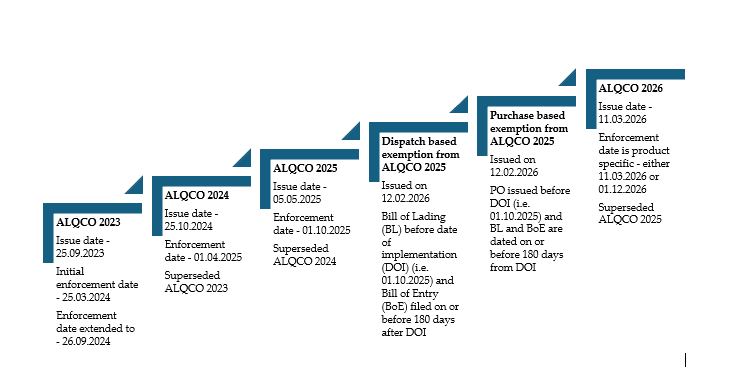
Despite the challenges faced by the industry and recent trend of withdrawal of certain QCOs, the Department for Promotion of Industry and Internal Trade(‘DPIIT’)issued a new Order on 11 March 2026, superseding the ALQCO 2025 and introducing the ALQCO 2026.
While the list of products and applicable Indian Standards remain unchanged from ALQCO 2025, the implementation dates have been revised to provide additional transition time to industry stakeholders.
The new ALQCO 2026 mandates conformity with applicable Indian Standards for the aluminium products listed in Table 1, with immediate effect, i.e. w.e.f. 11 March 2026. For aluminium products listed in Table 2, the conformity requirement has been deferred to 1 December 2026 for enterprises other than micro and small enterprises, 1 March 2027 for small enterprises and 1 June 2027 for micro enterprises.
Table 1 - List of Indian Standards, conformity with which is mandated with immediate effect
| Sl. No. | Indian Standards | Title of Indian Standard |
| 1 | 7092 (Part 1): 1992 | Aluminium alloy tubes for irrigation purposes – welded tubes. |
| 2 | 7092 (Part 2):1987 | Aluminium alloy tube for irrigation purposes - extruded tube. |
| 3 | 5484:1997 | EC Grade Aluminium Rod produced by Continuous Casting and Rolling. |
| 4 | 16011:2012 | Aluminium and aluminium alloy foil for pharmaceutical packaging. |
| 5 | 17682:2021 | Aluminium composite panel |
| 6 | 1254:2007 | Corrugated Aluminium Sheet |
| 7 | 7902:2001 | Aluminium alloy forging stock and forgings (Alloy 24345) for Aerospace applications |
(Source: ALQCO 2026)
Table 2 - List of Indian Standards, conformity with which is deferred at a future date.
| Sl. No. | Indian Standards | Title of Indian Standard |
| 1 | 733:1983 | Wrought aluminium and aluminium alloy bars, rods and sections (For General Engineering purposes). |
| 2 | 734:1975 | Wrought aluminium and aluminium alloys, forging stock and forgings for general engineering purposes. |
| 3 | 736:1986 | Wrought aluminium and aluminium alloy plate for general engineering purpose |
| 4 | 737:2008 | Wrought aluminium and aluminium alloy sheet and strip for general engineering purposes. |
| 5 | 739:1992 | Wrought aluminium and aluminium alloy wire for general engineering Purposes |
| 6 | 740:1977 | Wrought aluminium and aluminium alloy rivet stock for general engineering purposes. |
| 7 | 1285:2002 | Wrought aluminium and aluminium alloys-Extruded round tube and hollow sections for general engineering purposes. |
| 8 | 2067:1975 | Wrought Aluminium Wire for Electrical purposes |
| 9 | 21:1992 | Wrought aluminium and aluminium alloys for manufacture of utensils. |
| 10 | 5082:1998 | Wrought aluminium and aluminium alloy bars, rods, tubes, sections, plates and sheets for electrical applications. |
(Source: ALQCO 2026)
Way forward for manufacturers, suppliers, buyers and importers of regulated aluminium products
* For the shipments made prior to issuance of ALQCO 2026,
- Stakeholders should assess whether dispatch or purchase based exemptions provided under Orders dated 12 February 2026 can be claimed, particularly for consignments pending customs clearance due to non‑compliance with ALQCO 2025.
- In case of shipments made by small and micro enterprises, the ALQCO 2025 was enforceable w.e.f. 1 January 2026 and 1 April 2026, respectively. Since the Orders dated 12 February 2026 do not specifically exempt small and micro enterprises, and ALQCO 2025 provides specific date of implementation as 1 October 2025 (applicable to enterprises other than small and micro enterprises), small and micro enterprises cannot claim the exemption provided under Orders dated 12 February 2026.
* For the shipments made after issuance of ALQCO 2026
- Manufacturers of products covered under immediate enforcement (Table 1) must ensure that the products are complied with BIS licensing and marking requirements. Importers, distributors, and buyers should procure, store, and sell only BIS‑certified products. The manufacturers who have not obtained BIS licence for these products will face difficulties in selling/exporting without certification and without applying Standard Mark on the products.
- For products with deferred enforcement (Table 2), manufacturers should use the transition period to initiate BIS applications, upgrade quality systems, and engage with testing laboratories to ensure timely compliance, if the application process is not yet initiated.
Conclusion
Considering the extensive scope of products covered under the ALQCO 2026, their critical role in downstream industries, and prevailing geopolitical and supply chain uncertainties, businesses must proactively reassess procurement strategies, inventory exposure, and supplier compliance. Re‑examining sourcing arrangements, identifying alternative compliant suppliers, and evaluating the impact of non‑certified stock are essential to ensure business continuity. Effective collaboration between manufacturers, importers, and regulators will be key to achieving the QCO’s objectives while maintaining supply chain resilience.
[The authors are Partner and Manager, respectively, in BIS practice at Lakshmikumaran & Sridharan Attorneys, Mumbai]
Related Articles

Hallmarking Scheme of BIS: Safeguarding the purity of precious metals
Anjali Hirawat+120 May 2025
Discuss this topic with our BIS team
Contact Us